Welcome to the State of the Park Report. The State of the Park Report is a comprehensive assessment of the Lake District's current condition to highlight the successes and vulnerabilities that lie within this special landscape.
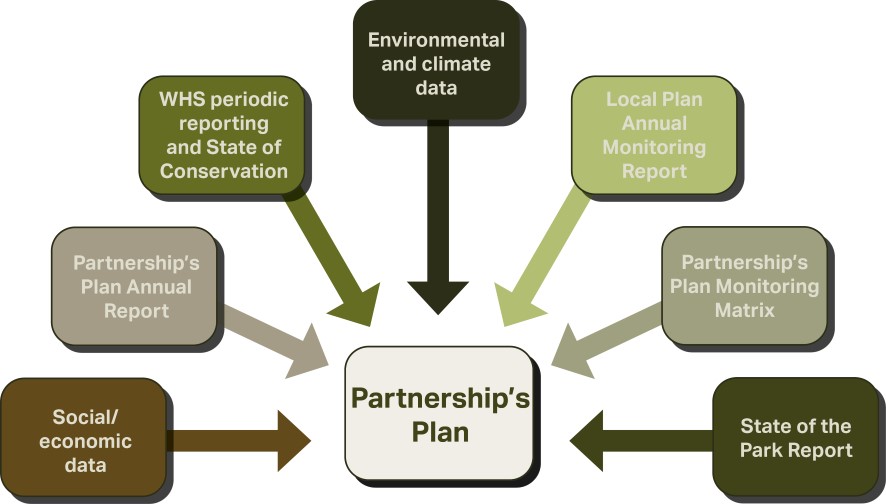
It is important that we monitor the condition of the Lake District over time. The State of the Park report's purpose is to provide as good a picture as possible of the Lake District, particularly in relation to the special qualities of the National Park. It contains information from a range of sources. However, it is important to understand that we cannot measure everything. Also the things we do measure should be relevant over a long period of time.
This State of the Park Report, produced on a five-yearly cycle by the Authority with support from other Partner organisations, provides:
(Click image to zoom in)
Data within this illustration is also in State of the Park Report
Condition: Moderate
Data within this illustration is also in State of the Park Report
There are several interventions in place that are having a positive impact on the condition of this Special Quality particularly in the context of the historic landscape, including the industrial heritage, semi-natural woodlands and the opportunities provided to enjoy the cultural landscape, for example through local shows and events.
The ‘moderate’ condition relates to the significant challenges, including impacts on the cultural landscape, such as the viability of farming, and the challenge of climate change. Climate change is one of the factors affecting the condition of our important habitats and wildlife and these effects will require future monitoring and investment to understand the impacts in more detail and to enable the Lake District to adapt to changes in the landscape
The cultural landscape continues to be a source of artistic inspiration and provides opportunities for quiet enjoyment. Latest visitor profile data highlights a clear shift towards an increasing proportion of more diverse and younger visitors; a visitor profile that better reflects today’s national population. Visitor numbers have almost returned to pre-2019 levels but patterns of visits have changed as a result of the covid pandemic.
The next few years will show if numbers continue to grow based on past trends or are levelling off, but continued and increased investment is also needed to maintain the public rights of way network and access routes on the High Fells to reduce erosion and enable public enjoyment. Some of these pressures on key routes and places may be eased through ‘attract and disperse’ strategies.
Condition: Good
Data within this illustration is also in State of the Park Report
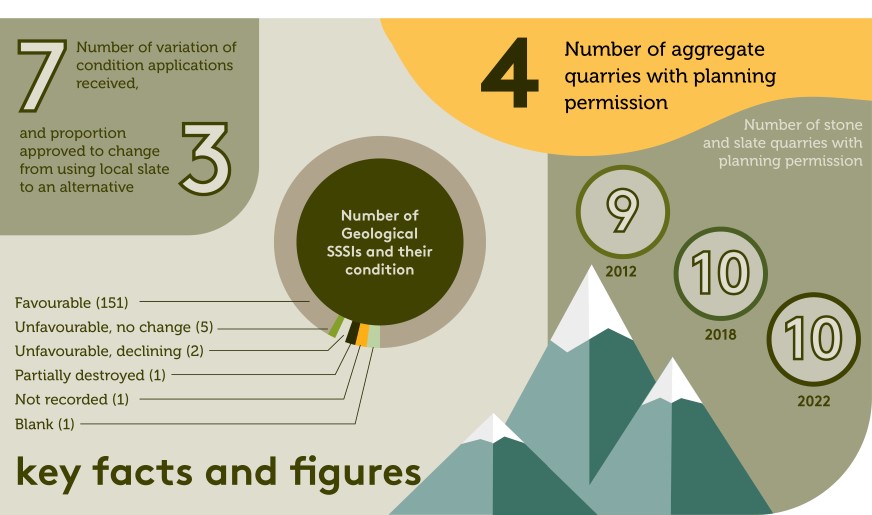
Quarrying and mining is a recognised part of our cultural landscape and industrial heritage. It has also greatly influenced the distinctive characteristic of the Lake District. There has been no significant change in the number of quarries with permission to extract minerals, and the Lake District National Park Authority (LDNPA) has adopted Planning Policies to ensure local natural and mineral resources are safeguarded from the pressures of development.
The rich quarrying and mining history is supported and enjoyed by many people, because the continued low key extraction of minerals helps to support the repair of traditional buildings and ensure that new buildings have a sense of place and contribute to the local distinctiveness of the Lake District.
Condition: Good
Data within this illustration is also in State of the Park Report
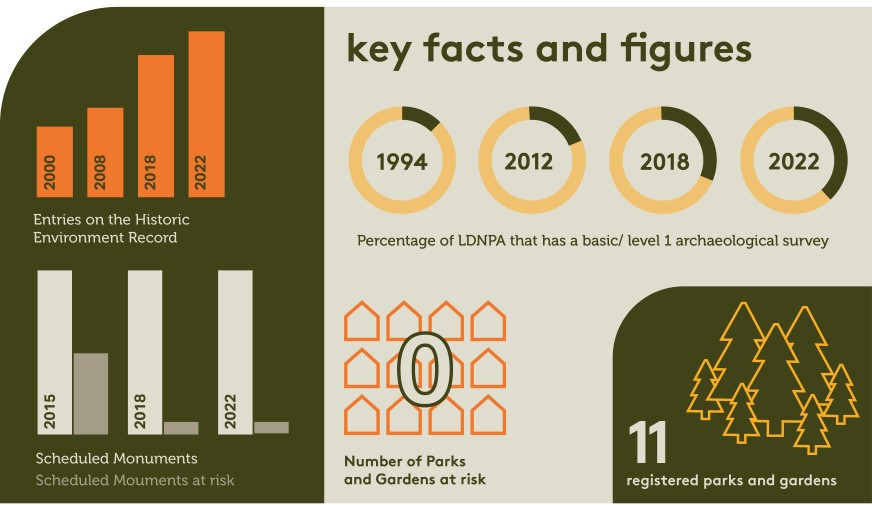
The landscape, buildings and ruins, walls and historic remains are just some of the features that make up the historic environment. The trend for each indicator is in line with the ideal status as a result of a number of conservation projects and interventions being delivered, maintaining and protecting the archaeology and historic landscape of the Lake District.
There have been considerable increases in the area of the National Park surveyed and increases in the number of entries in the Historic Environment Record which contribute to improved knowledge and understanding of features in the Lake District.
Condition: Moderate
Data within this illustration is also in State of the Park Report
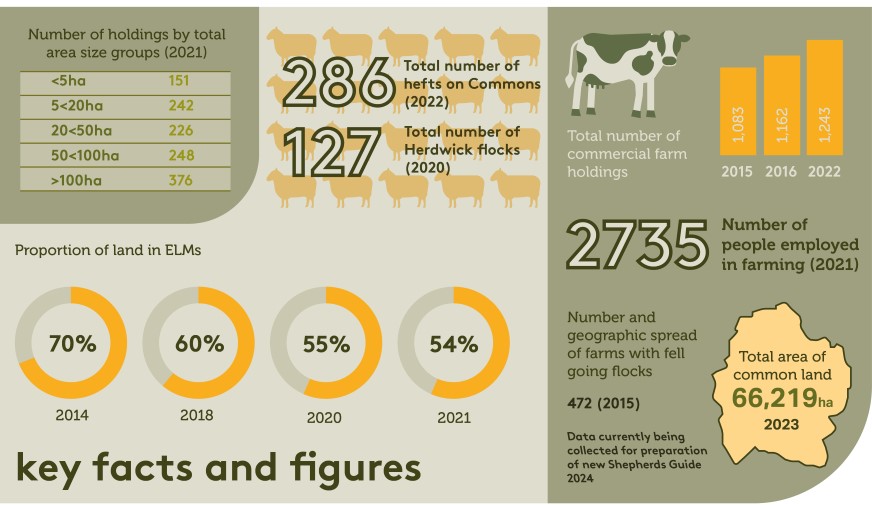
The world class cultural landscape of the Lake District is intrinsically linked to farming heritage and practices that takes place on the land, including on commons. There are many potential risks to this Special Quality as highlighted by the indicators. Some trends are in line with the ideal status of the indicators, but many are not. The decreasing amount of land in Agri-environment Schemes is a significant concern.
The direct area-based payments of the Basic Payment Scheme will be reduced by at least 50% for all farms by 2024 compared to 2021 levels of payment. The impact of a smaller amount of land in Agri-environment Schemes is that less money is coming into the Lake District and less land is delivering environmental improvements and other public goods. However, the Farming in Protected Landscapes programme has been a great success in delivering investment to support climate, nature, people, and places.
The outcome of changes to farming practices and critical payments for land management might be contributing to changes to the management of the commons, to the number of farm holdings, and holding size. The last five years has seen notable increases in small farms (under five hectares) and a decline in farms over 100 hectares in size and a greater proportion of land being used for other land uses than farming.
There has also been a notable decrease in hefted flocks on commons but stable numbers of hefted Herdwick flocks. There is a clear need to ensure activity continues to support this Special Quality and secure greater investment to support the future of farming and forestry, nature recovery and climate change.
Condition: Moderate
Data within this illustration is also in State of the Park Report
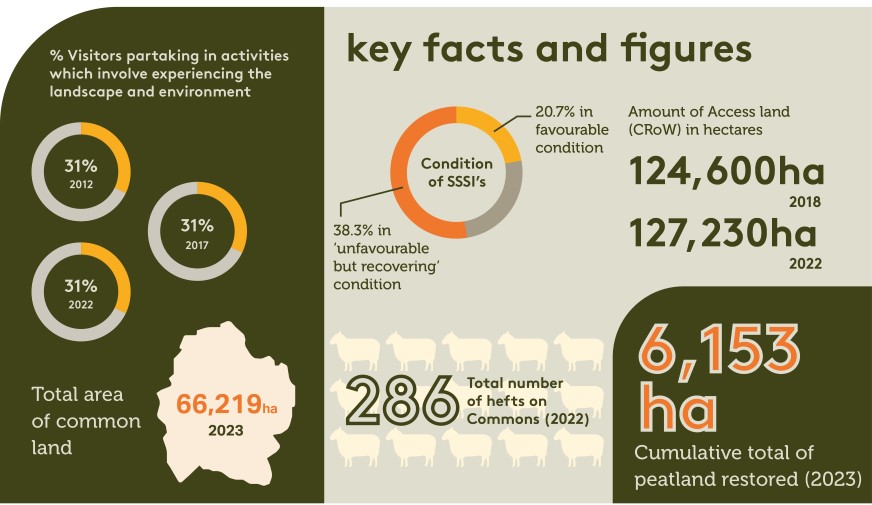
The high fells are distinct and easily recognisable, creating a strong sense of place. The features including large areas of common land, public rights of way, areas of habitat, and archaeology mean that this Special Quality is captured through indicators of other Special Qualities.
Current interventions are helping to deliver positive outcomes such as greater carbon storage, improved access, and nature recovery but increased activity is needed to improve the condition of the high fells and deliver for nature, mitigate and adapt to the effects of climate change, and for social, economic, and cultural objectives.
Condition: Moderate
Data within this illustration is also in State of the Park Report
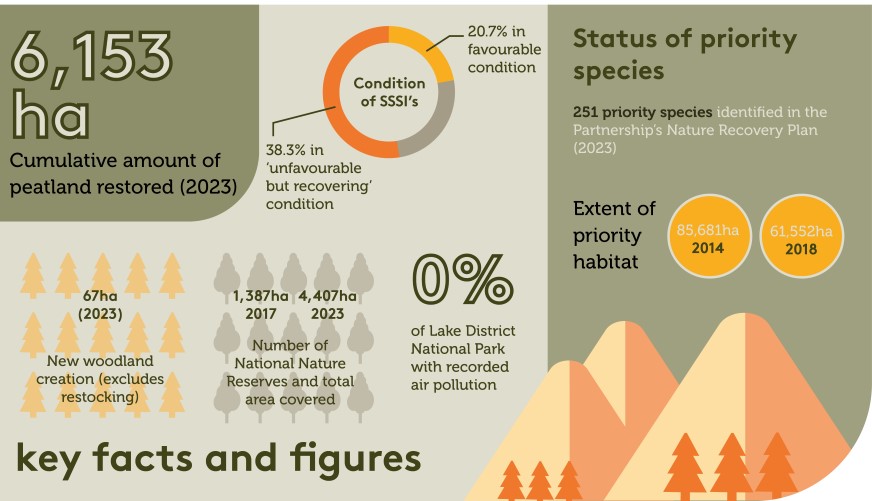
Almost 20% of the National Park area is designated for its biodiversity value so it is unsurprising that the Lake District is home to internationally important species, and a variety of habitats. The nationwide decline in biodiversity is well known and understood, and the Lake District has not been immune to this worrying trend. In the last 20 years much work has been done to try to maintain and restore existing habitats and species in the National Park, and lots of activity is being delivered to support nature recovery and improve the wealth of habitats and wildlife in the Lake District by the Partnership and other organisations.
However, there is still much to achieve and a lack of up to date and available data continues to seriously hamper understanding and progress to improve habitats and the abundance of wildlife. Where data is available, for example condition of SSSIs, there has been a decrease in the favourable condition of SSSIs since the last State of Park Report. Peatland continues to be restored but more needs to be restored each year to achieve the Partnership Plan’s ambitious targets.
Condition: Moderate
Data within this illustration is also in State of the Park Report
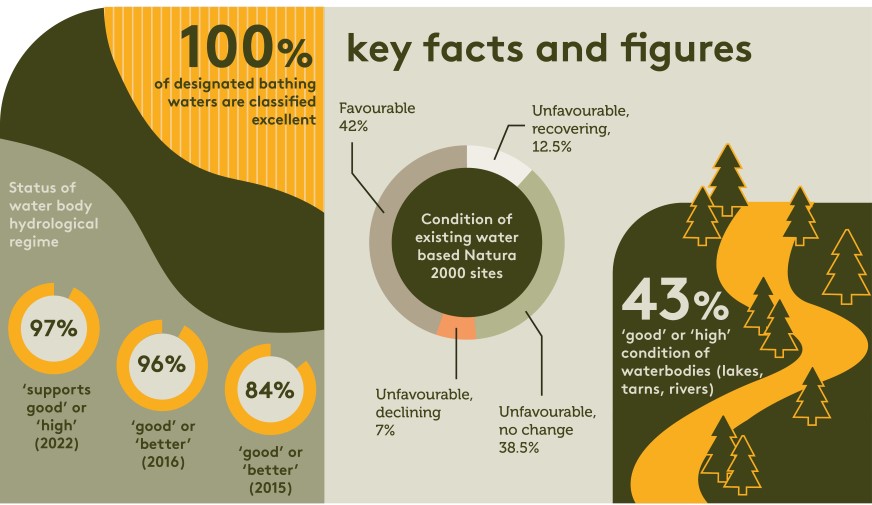
Water is synonymous with the Lake District, it rains a lot and there are many lakes, tarns and meres, and water courses which are being enjoyed by an increasing number of people. The condition of some water bodies in particular has received attention from media campaigns seeking to improve water quality, and in 2022 Nutrient Neutrality guidance was introduced by Natural England on four catchments affecting the Lake District as a result of high nutrient levels.
However, the indicators show there has been a gradual improvement in water quality over the last 10 years, with focussed activity from the Partnership contributing to this, but a lot more work and investment is needed to help ensure the water environment continues to provide for the range of habitats and species they support and can be relied upon as a natural resource for all to enjoy.
Condition: Good
Data within this illustration is also in State of the Park Report
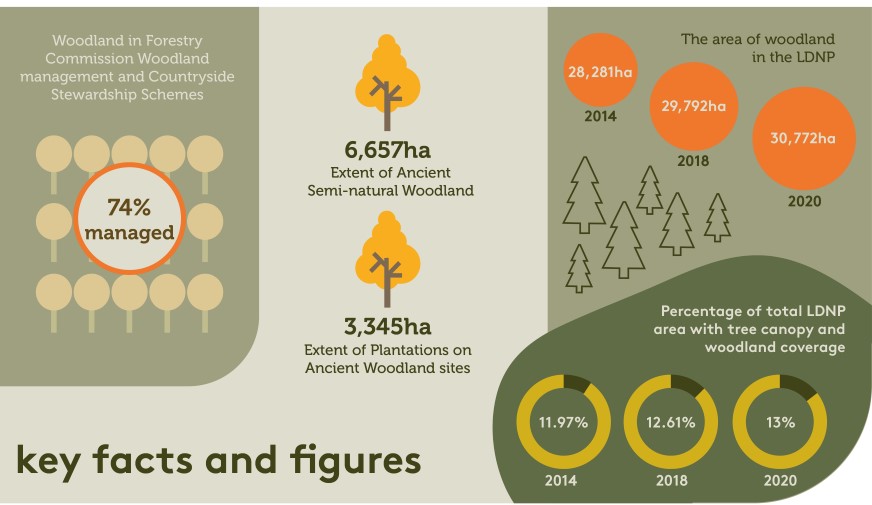
The area of woodland cover in the Lake District has continued to increase since the last State of the Park Report and there has been no loss of Ancient Semi-Natural Woodland. This is as a result of a significant amount of activity that continues to be delivered by the Partnership, but there are concerns that the rate of tree planting will not meet the ambitions outlined in the Partnership’s Plan of at least 17% cover by 2050. Woodlands do remain vulnerable to the effects of climate change, invasive species, and disease, yet there are methods of protection and interventions taking place that are aimed at securing a positive future for these important habitats.
Condition: Moderate
Data within this illustration is also in State of the Park Report
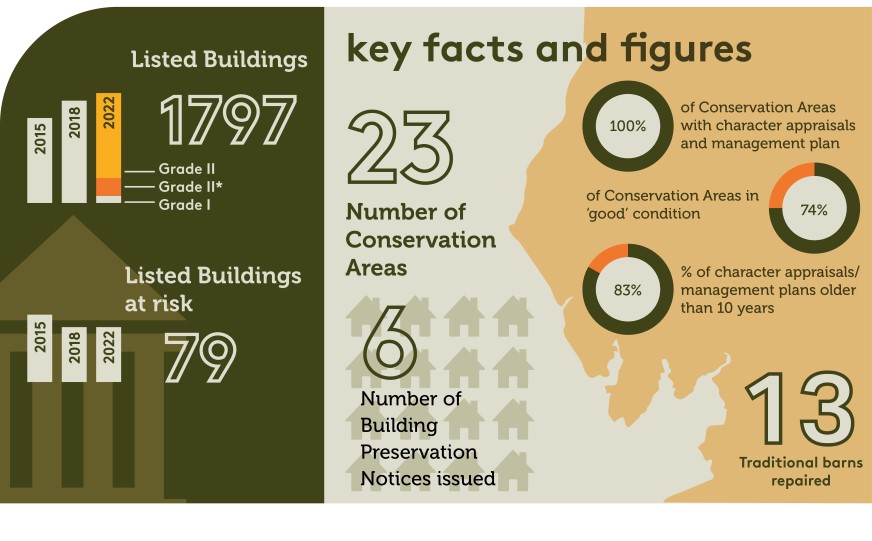
Distinctive buildings and settlement character are a key feature of the towns, villages, hamlets, and landscape of the Lake District. The indicators show that trends for most indicators are moving in a positive direction with interventions such as Building Preservation Notices and that 100% of Conservation Areas have Management Plans. This helps to support and promote the importance of the Lake District’s traditional vernacular and sense of place. It is hoped that the Lake District Design Code Supplementary Planning Document will help to prevent inappropriate changes to the Lake District’s distinctive buildings and reinforce the settlement character through new developments.
However, there remain concerns that important features of buildings are being eroded through changes to the use of buildings and to address issues such as energy performance. The grant schemes to repair traditional buildings has helped to remove buildings from the Heritage at Risk register. The main concern highlighted by the indicators is that the 83% of Conservation Area Appraisals and Management Plans are more than 10 years old.
Condition: Good
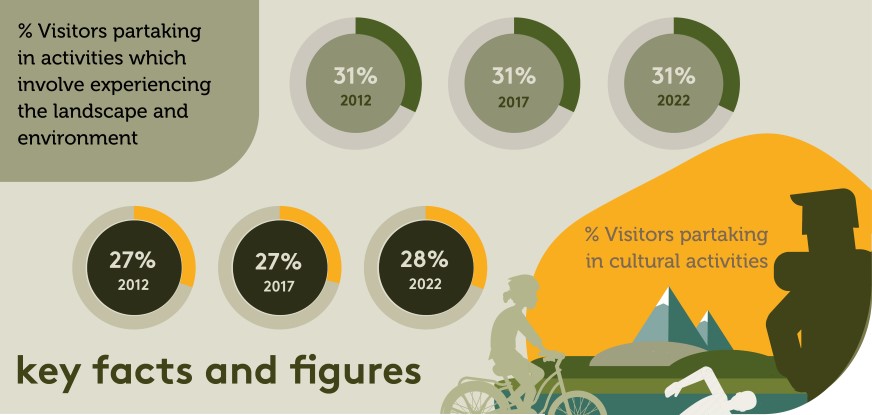
Data within this illustration is also in State of the Park Report
The Lake District continues to be a source of artistic inspiration and is enjoyed and expressed through a variety of books, photographs, sculptures, paintings and digitally via social media. There are also many festivals and events that take place throughout the year which provide the opportunities for people to explore their relationship with nature, and where the cultural landscape provides artistic inspiration or spiritual or physical refreshment.
Condition: Good
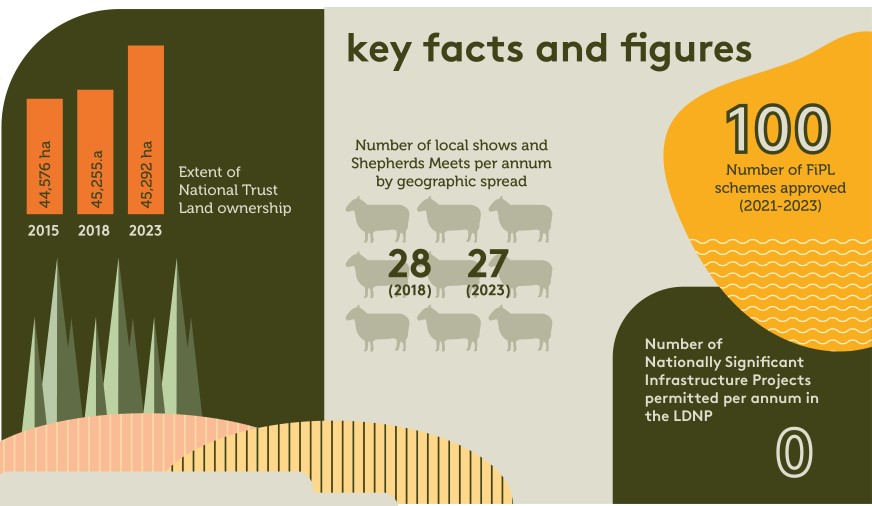
Data within this illustration is also in State of the Park Report
Plans, policies and strategies are in place to further the conservation and enhancement of the extraordinary harmony and beauty of the Lake District, its Special Qualities and international and national significance, including the protection of the relationship being people and the natural environment.
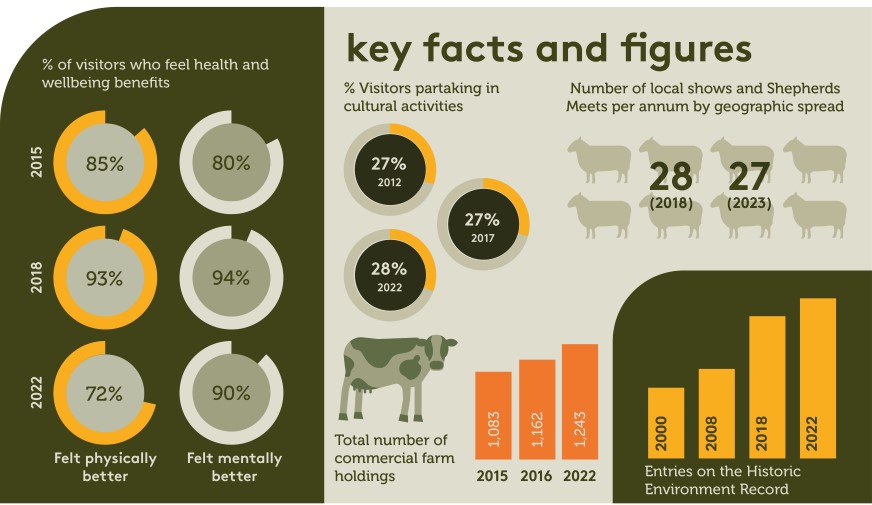
National Park designation and World Heritage Site inscription and the collective work of members of the Partnership support this, and the indicators highlight good trends – National Trust land ownership has increased and the number of local shows and shepherds meets has almost remained the same. The Farming in Protected Landscapes Programme is also supporting the conservation of the cultural landscape through its four themes of people, place, nature, and climate.
Condition: Good
Data within this illustration is also in State of the Park Report
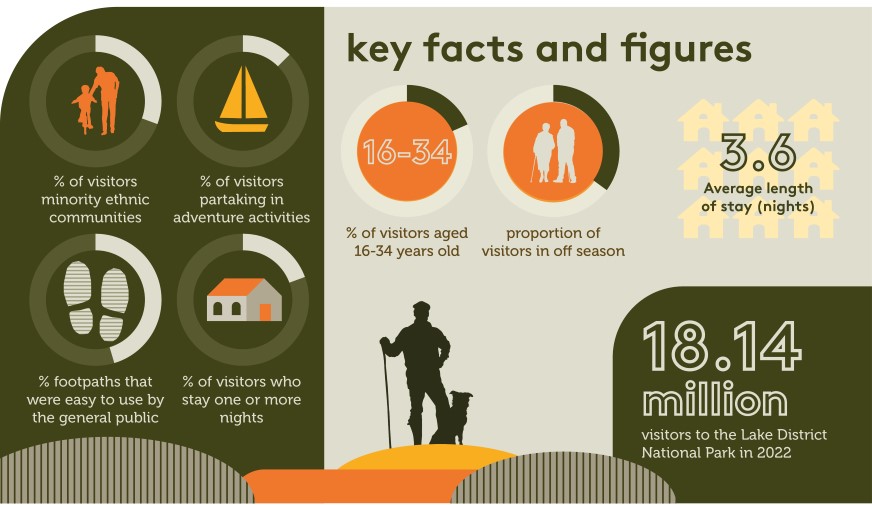
In 2022, 18.14 million visited the Lake District and 96% of visitors rate their visit as ‘very good’ or ‘good’. Tourism and outdoor activities have been significantly affected since the last State of the Park Report in 2018, primarily as a result of the Covid-19 pandemic but a number of positives have also emerged. As restrictions lifted a new audience of visitors discovered the Lake District, and the latest data shows they continue to enjoy the Lake District and this Special Quality.
Whilst visitor numbers haven’t quite reached the numbers in 2019, the proportion of visitors aged 16-34 has increased by 6%, and visitors from minority ethnic communities increased to 22% in the Lake District and 16% across Cumbria representing a 14% increase. This demonstrates a visitor profile that better reflects today’s national population and that the Lake District is a place for everyone.
The average length of stay has decreased but the proportion of visitors who stay more than one night has increased. Visitors are still partaking in cultural and adventure activities at the same levels, and the number of ‘Miles without Stiles’ routes has increased.
The trends for the indicators for this Special Quality are encouraging given the global pandemic, apart from the ease of use of the rights of way network, which has seen a significant decline in ease of use since 2018, and action is needed to address this decline as walking and cycling infrastructure is at the heart of the visitor offer.
Condition: Good
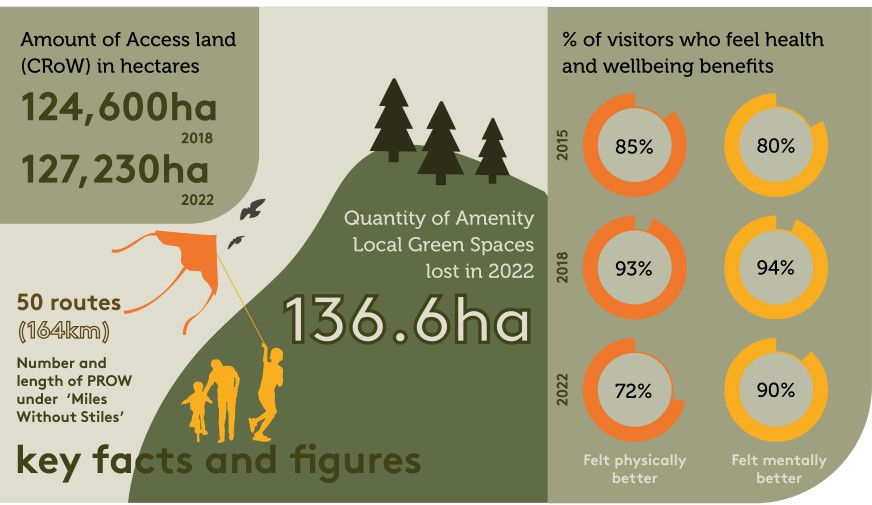
Data within this illustration is also in State of the Park Report
The Lake District continues to provide many opportunities for quiet enjoyment and there have been many significant investments in improvements to multi-user trails, and rights of way over the last five years which has enabled more people to enjoy health and wellbeing benefits associated with being in a National Park.
The number of people reporting feeling physically better has fallen but the percentage of people who feel mentally better has remained almost the same. There continues to be significant amounts of different accessible green infrastructure available across the Lake District for people to enjoy without any notable losses of greenspace.
The Lake District is a cultural landscape with various distinctive qualities, each requiring specific attention and actions. While the overall condition is moderate to good, significant efforts and resources are needed to overcome challenges posed by climate change, farming sustainability, nature recovery, water quality, and tourism impacts and access to the countryside.
Encouragingly, the Lake District remains a source of inspiration and a model for protecting cultural landscapes, showcasing its enduring importance and ambition to be an inspirational example of sustainable development in action as outlined in the Partnership’s 2030 Vision.
Through targeted interventions, increased collaboration, and strategic planning, the Lake District can continue to evolve as a resilient, harmonious landscape that preserves its natural and cultural heritage for future generations. The State of the Park Report highlights some key issues that need to be addressed due to declining trends:
A number of other issues that are reported through other mechanisms, that also feed into the preparation of the next Partnership’s Plan, will also need to be subject to the Partnership’s focus.
The latest Census data shows that the resident population continues to decline, business surveys highlight a shortage of available workforce, the Cumbria Visitor Survey highlights an increased use of private vehicles to travel around the Lake District, and the Local Plan evidence base highlights challenges around the affordability of housing for working people and low numbers of affordable housing being built, coupled with increasing numbers of holiday lets in many of the Lake District’s Settlements.
Visitor numbers have almost returned to pre-2019 levels but patterns of visits have changed as a result of the covid pandemic. The next few years will show if numbers continue to grow based on past trends or are levelling off.
Some recommendations begin to emerge through the analysis of the indicators which will need to be explored by the Authority and the Partnership through the preparation of the next Partnership Plan.
Special Qualities are characteristics that distinguish National Parks from each other and from other parts of the country. For the Lake District these are:
Outstanding Universal Value (OUV) means cultural and, or natural significance which is so exceptional as to transcend national boundaries and to be of common importance for present and future generations of all humanity.
The Special Qualities of the Lake District contribute in different ways to the Outstanding Universal Value of the area recognised by World Heritage Site Status. Each of the attributes of Outstanding Universal Value are specific aspects of each of the Special Qualities.
This report provides an overview of the state of the Lake District National Park in 2023.